From ranked links to synthesized answers
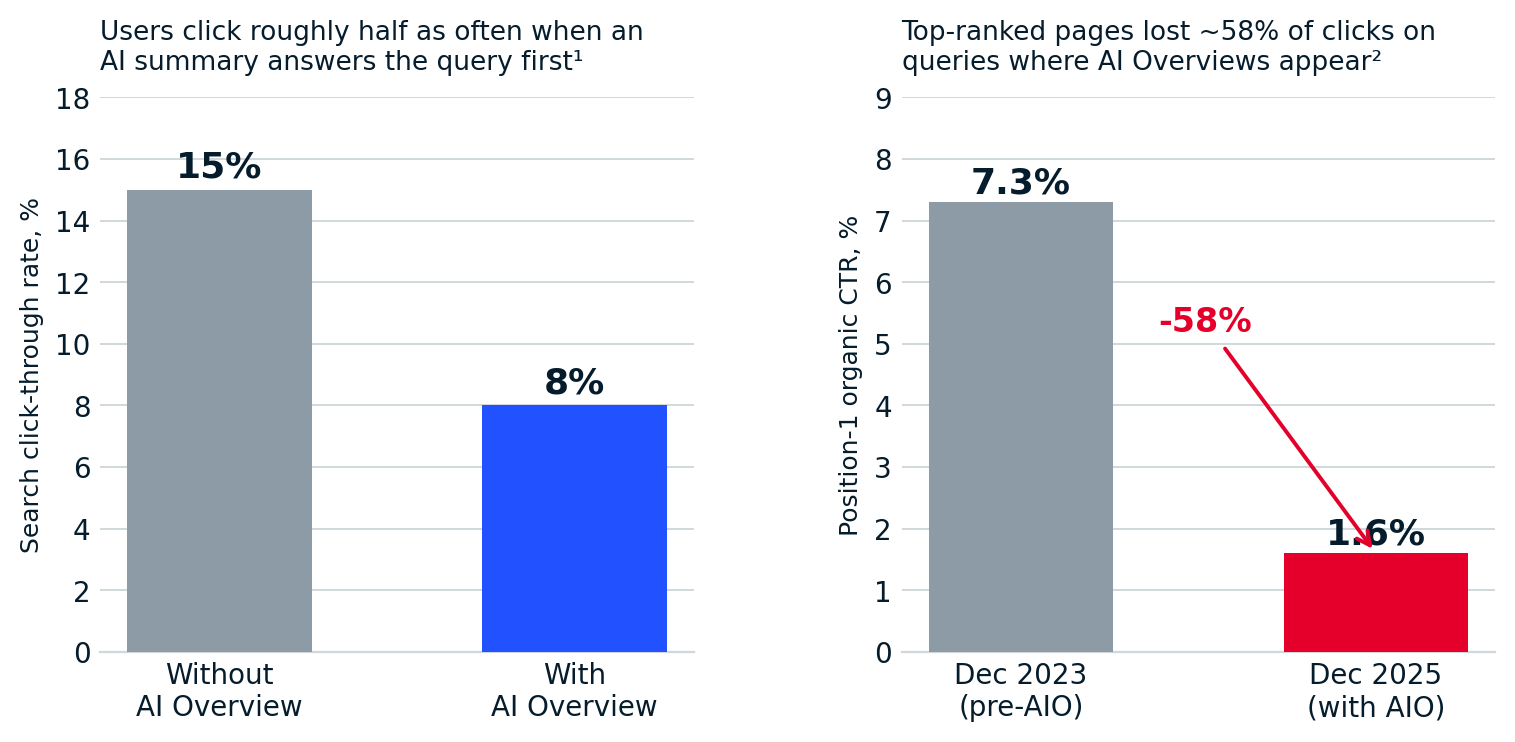
Generative engines do not rank; they compose. When a user asks a question, systems built on large language models retrieve candidate passages from indexed sources, weigh them for relevance and authority, and generate one integrated answer — typically citing between two and eight sources, and frequently satisfying the user without any click-through at all. Analyses across 2025 found that when Google displays an AI Overview, user click-through drops from about 15 percent to 8 percent, and only around 1 percent of searches result in a click on a link inside the AI answer itself.5 Independent measurement of 300,000 keywords found position-one organic results losing roughly 58 percent of their clicks when an AI Overview is present, and a randomized field experiment measured a 38 percent causal reduction in outbound clicks.6,22
The aggregate effect is what analysts have called the great decoupling: total search volume keeps rising while clicks to websites decline. Roughly 60 percent of searches now end without any click, and Google search traffic to publishers fell by approximately one-third in the twelve months to November 2025.8,23 Gartner's projection that traditional search engine volume would fall 25 percent by 2026 — treated as provocative when issued — now looks conservative in several categories.9
Health queries sit at the epicenter of this shift. Informational queries trigger AI Overviews far more often than transactional ones — around 88 percent of AI Overview triggers are informational — and health consistently ranks among the categories with the highest AI-answer prevalence and the fastest user adoption of AI-first search, with one industry analysis finding health among the year's most-adopted AI categories at 2.9 times the baseline rate.13,21
Clinicians: from cautious pilots to daily infrastructure
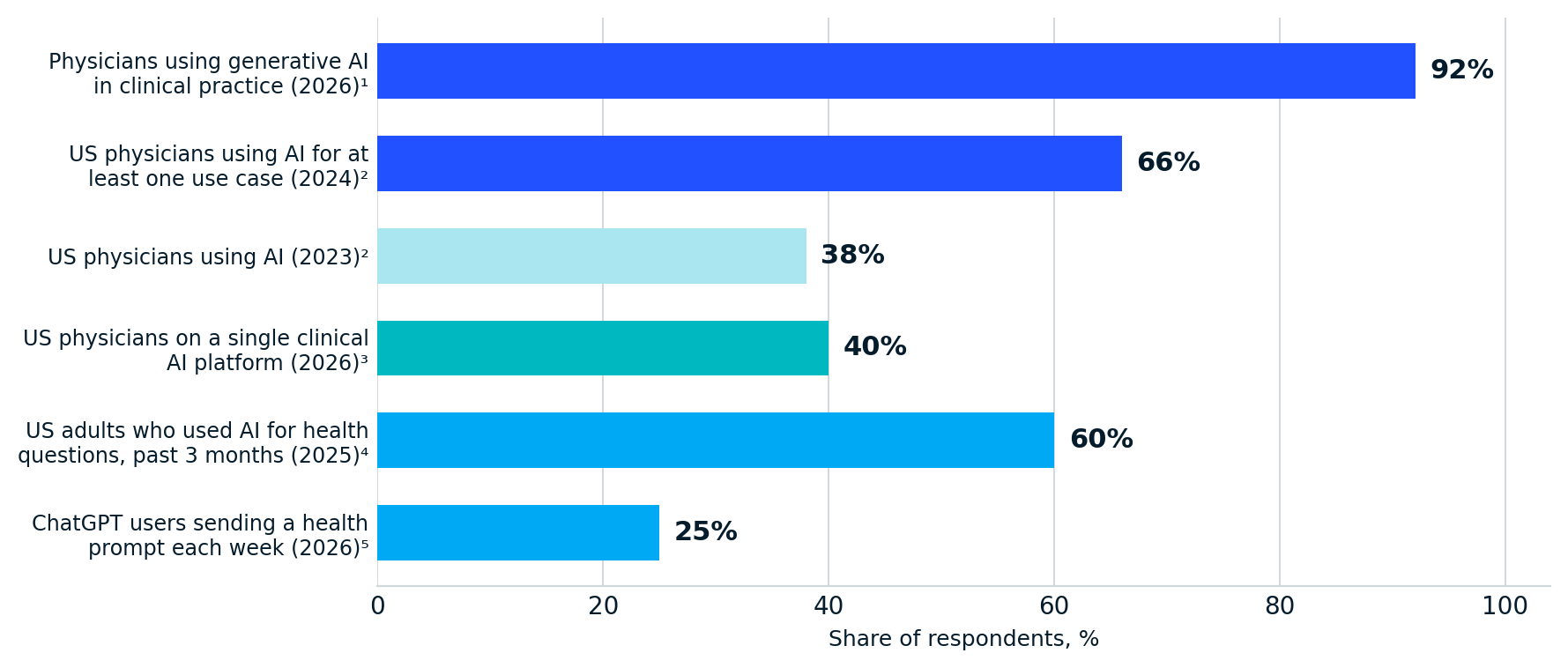
Physician adoption of AI did not follow the slow diffusion curve typical of health technology. Surveys by the American Medical Association recorded the share of US physicians using AI for at least one use case rising from 38 percent in 2023 to 66 percent in 2024, with more recent AMA-cited polling putting overall usage above 80 percent.4 A March 2026 international survey of 1,165 physicians across fifteen specialties in seven countries found that 92 percent use generative AI — general-purpose or healthcare-specific — in their clinical practice.2
The most striking single datapoint is the rise of specialized clinical answer engines. One platform restricted to verified clinicians grew from roughly 3 million clinical consultations per month in late 2024 to more than 20 million per month by January 2026, reporting over 757,000 verified physician users — more than 40 percent of practicing US physicians — across more than 10,000 hospitals, and reaching a $12 billion valuation on the strength of that reach.3 These clinical AI platforms are walled gardens: they ingest only sources they deem clinically validated, typically peer-reviewed journals, regulatory documents, and guideline bodies. A manufacturer whose evidence is absent from those ingestion pipelines is absent from a large and growing share of point-of-care decision moments.2,3
Patients: healthcare's new front door
On the consumer side, OpenAI's January 2026 usage analysis reported that more than 5 percent of all messages on its platform globally relate to healthcare, that roughly one in four of its 800-million-plus weekly users sends a health prompt every week, and that more than 40 million Americans ask health questions daily.1 Survey data in the same report found that three in five US adults had used AI tools for health questions in the prior three months; 55 percent used AI to check symptoms, 48 percent to decode medical terminology, and more than 40 percent to research treatment options.1 Seven in ten of these conversations occur outside clinic hours — precisely the moments when no professional intermediary is available to correct a wrong answer.1
The implication for pharmaceutical companies is uncomfortable but clarifying: the first substantive conversation a patient has about a therapy is now frequently with a statistical model, not with a clinician, a pharmacist, or the brand's own website. A separate analysis of biotech website audiences found that 58 percent of visitors who arrive via Google also use ChatGPT — the AI conversation and the website visit are already the same audience at different moments.11 And among users of AI-powered search generally, McKinsey research finds 44 percent already treat AI as their primary source of insight, versus 31 percent for traditional search.12
What changed, in one sentence
The strategic asset is no longer the destination (a website that must be found) but the substrate (structured clinical truth that machines can retrieve, interpret, and repeat) — and most pharmaceutical content was engineered for the former.