5.1 The three-tier content architecture
All content that shapes AI answers about a medicine can be assigned to one of three tiers, defined by authority and control. The tiers are not equally important, and they are not managed the same way.
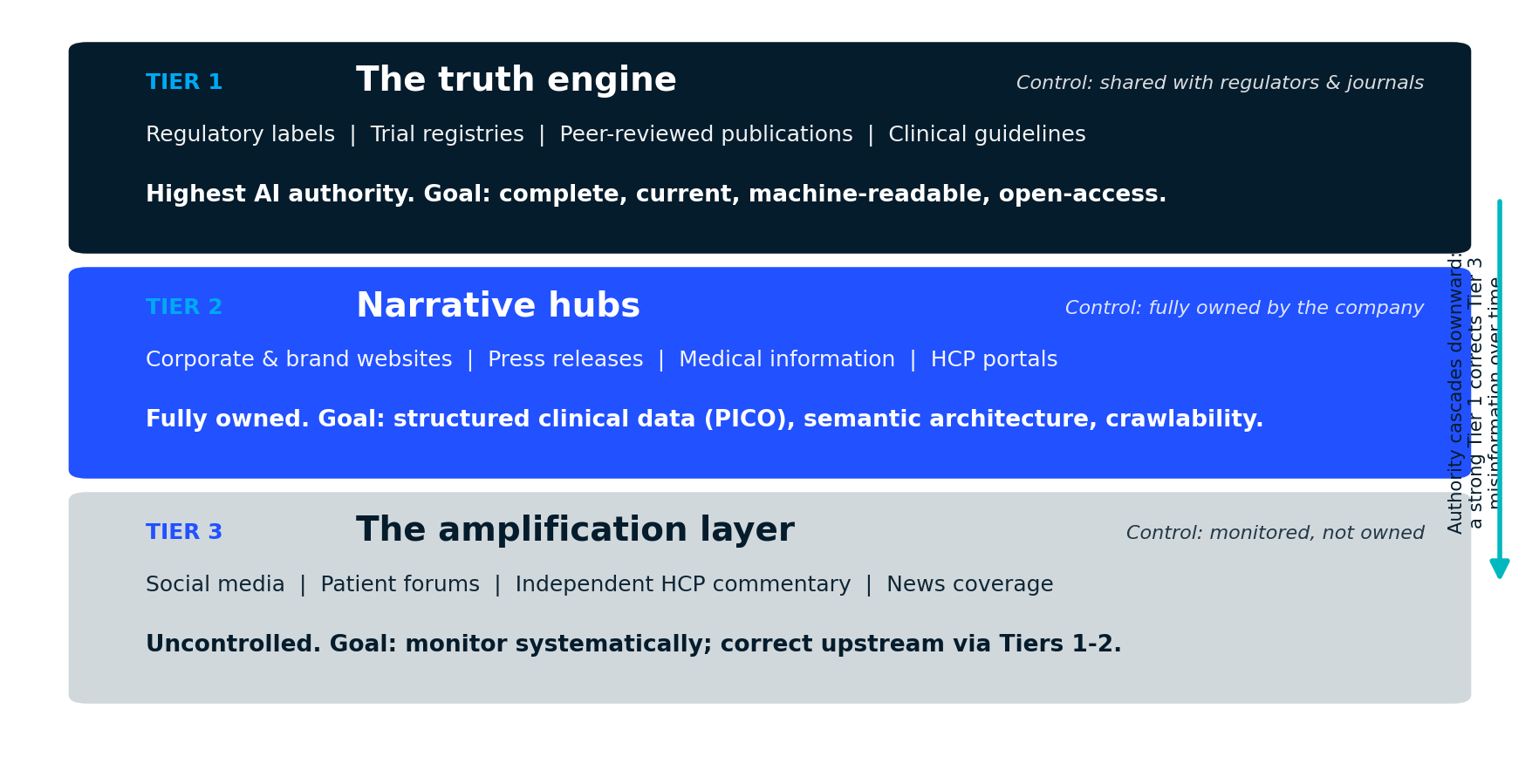
- Tier 1 — the truth engine. Regulatory labels and their public repositories, trial registries, peer-reviewed publications, and clinical guidelines. These carry the highest machine-assigned authority and anchor every downstream answer. The manufacturer shares control with regulators, journals, and societies — but controls completeness, currency, open-access status, and the structured summaries that surround them. Goal: every Tier 1 asset complete, current, canonical, and machine-readable.
- Tier 2 — narrative hubs. Corporate and brand websites, press releases, medical-information content, and HCP portals. Fully owned, fully controllable — and, in audits, dramatically under-cited relative to their accuracy. Goal: convert this estate from promotional prose to structured clinical data with semantic architecture, so it becomes the connective tissue linking Tier 1 evidence to user questions.
- Tier 3 — the amplification layer. Social platforms, patient forums, independent clinician commentary, and news coverage. Uncontrolled and unsuppressible. Goal: systematic monitoring with defined escalation triggers — and the strategic understanding that Tier 3 errors are corrected upstream, by strengthening Tiers 1 and 2, not by chasing individual posts. Audit evidence supports the cascade: models resolve conflicts between tiers in favour of higher-authority sources when those sources are retrievable.19
5.2 Sequencing across the product lifecycle
GEO priorities shift predictably as an asset moves from clinical development to post-launch maturity. The heat map below summarizes where effort concentrates in each phase; three dynamics explain it.
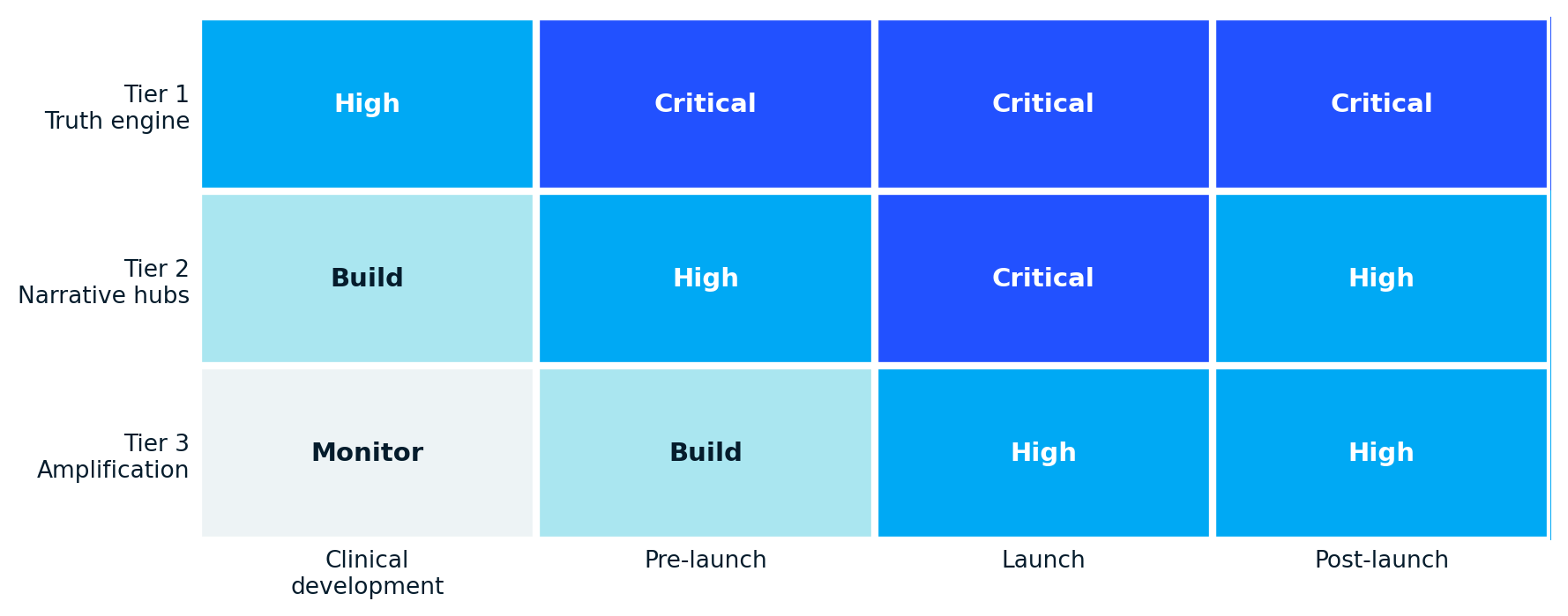
- Clinical development sets the baseline narrative. Trial registrations, early publications, and encyclopedic sources indexed in this phase become the training-data substrate every later answer builds on. Registry completeness and structured protocol summaries are cheap now and expensive to retrofit. Errors seeded here — a vague endpoint description, an outdated registry entry — persist for years.19
- Launch is a canonicalization event. The approved label becomes the single most-cited source across models; the launch window determines whether the canonical label URL, the regulatory repository entry, the approval press release, and the third-party aggregator entries all align. Getting the launch-week content architecture right is the highest-leverage GEO intervention in the entire lifecycle.19
- Post-launch is version management. Every label supplement is a full GEO re-launch: the updated version must become dominantly indexed, explicitly marked as superseding, and cascaded to every owned and managed third-party surface within days. Real-world evidence and meta-analyses gain citation weight over time and shape comparative narratives; whoever publishes the accessible synthesis frames the class.19
5.3 The PICO standard: pre-approvable structure for machine-readable claims
The single most transferable content practice observed across successful remediations is the conversion of narrative efficacy claims into PICO-structured statements: Population, Intervention, Comparator, Outcome — with explicit statistics, confidence intervals, data-cut dates, and co-located safety context. The format is native to evidence-based medicine, which is precisely what makes it powerful: medical, legal, and regulatory reviewers can pre-approve a PICO template once and apply it across assets, converting GEO from a per-asset negotiation into a governed production standard.16,17
A before-and-after illustrates the mechanism. The promotional sentence "Patients experienced significant and rapid improvement in disease control" gives a retrieval system nothing: no population, no number, no comparator, no timeframe. Its PICO conversion — "In adults with [biomarker-defined disease] (Population), [therapy, dose, schedule] (Intervention) versus [comparator] (Comparator) achieved an objective response rate of X percent (95% CI: a–b) at the pre-specified analysis, data cut [date] (Outcome); the most common grade ≥3 adverse events were [events], and no dose adjustment is required for mild renal impairment" — is retrievable, quotable, attributable, and safe to reuse. Every element maps directly to the interventions the peer-reviewed GEO evidence found most effective: statistics, quotable statements, and explicit sourcing.10